
The Feynman technique: 4 steps, a worked example and the evidence
By the Braintoll team · · 8 min read
The short answer
The Feynman technique is a way to test whether you understand something: pick one concept, explain it in simple words without notes, go back to your source wherever you get stuck, then simplify and test the explanation on a new example. Richard Feynman didn't invent the named method. Scott Young coined it in 2011, loosely based on Feynman's habits. No study has tested it as a package, but research on self-explanation supports the idea. It's best for concepts, not vocabulary or bare facts, and it doesn't replace practice problems or later review.
On this page
You’ve read the chapter twice and it all makes sense. Then someone asks you to explain it, and after two sentences you’re stuck. The Feynman technique uses that moment on purpose: you try to explain a topic in simple words, because the places where you stall show you exactly what you haven’t understood.
The Feynman technique in 4 steps
- Pick one small concept. Not “cell biology”, but “how osmosis works”. The tighter the topic, the harder it is to hide a gap.
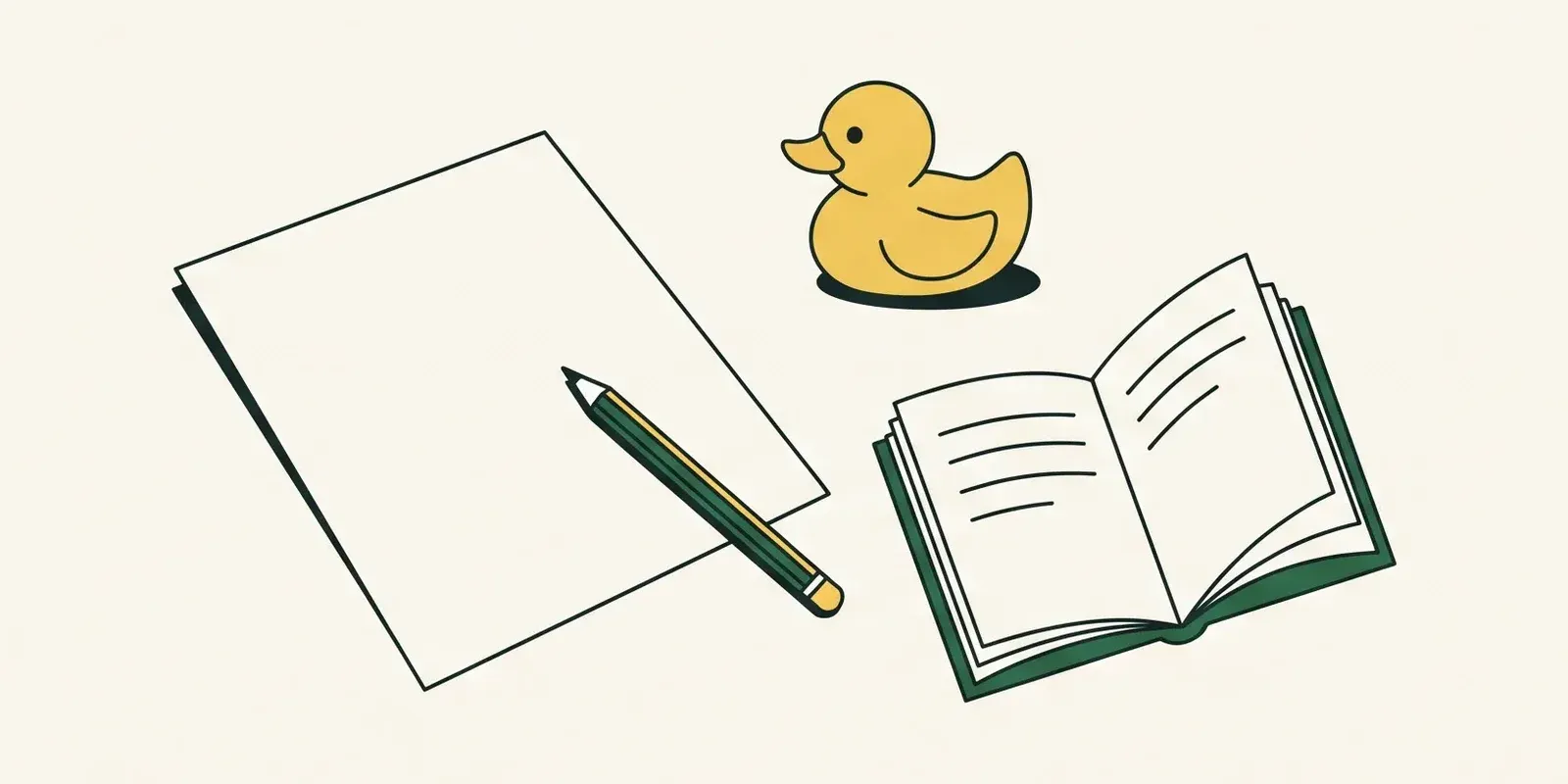
- Explain it on a blank page, without notes. Write as if to someone who has never taken the course. You can also say it out loud to a friend or a rubber duck.
- Go back to your source where you got stuck. Circle every point where you hesitated, stayed vague or copied a technical term without being able to say what it means. Read up on those points only, then close the book again and rewrite that part.
- Simplify, then test it on a new case. Replace the jargon, add an example, and use your explanation to answer a question you haven’t seen. If it can’t, repeat from step 2.
Then one step the usual versions leave out: come back to it a few days later. Understanding something today doesn’t mean you’ll still be able to explain it next month, so turn your explanation into a couple of questions and review them with spaced repetition.
A worked example: osmosis
First attempt, without notes:
Osmosis is when water moves across a semipermeable membrane along a concentration gradient.
It sounds right, and it could be copied from a textbook. Try to explain each term, though, and the gaps appear: What does semipermeable let through? Gradient of what? Which way does the water go, and why?
After checking the source and simplifying:
Picture a thin skin with tiny holes. Water fits through, but dissolved salt doesn’t. If one side is saltier, more water passes toward the salty side than comes back, until the two sides even out or the pressure stops it.
Testing it on a new case: why does a salted salad go limp? The salt on the leaves’ surface is more concentrated than the liquid inside their cells, so water flows out of the cells and they lose their firmness. The explanation holds, so you’ve understood it at this level.
Notice what didn’t happen. The simple version isn’t the whole of the science, and that’s fine for now. If the course goes further, the next round starts where this one stops: what exactly stops the flow?
Afterwards, make cards:
| Front | Back |
|---|---|
| Which way does water flow through a membrane that blocks salt? | Toward the saltier side |
| Why does a salted salad go limp? | Water leaves the cells toward the saltier surface |
Our guide on how to make flashcards shows how to write more of them.
Did Feynman really invent it?
No. Richard Feynman, the Nobel Prize-winning physicist known for his clear teaching, never described a method like this. The name comes from Scott Young, who used it for a video in 2011 and later wrote that the technique is only loosely based on Feynman’s practices. Young’s own version has three steps. The four-step form, with simplifying as its own step, spread afterwards.
The link to Feynman is still real, in three well-documented stories:
- The notebook. Before his oral exams at Princeton, Feynman began a notebook titled “Notebook of Things I Don’t Know About” and spent weeks taking each branch of physics apart, according to James Gleick’s biography.
- The freshman test. When a colleague asked him why particles of spin one-half obey Fermi-Dirac statistics, Feynman promised a freshman lecture on it. He came back days later: “I couldn’t reduce it to the freshman level. That means we don’t really understand it.”
- The bird. Feynman told how his father taught him the difference between knowing a bird’s name and knowing the bird: “You can know the name of that bird in all the languages of the world” and still know nothing about it.
You’ll often see the line “If you can’t explain it simply, you don’t understand it well enough” attributed to Feynman or Einstein. We couldn’t find a reliable source for it for either of them.
Does the Feynman technique work?
Nobody has tested the four steps as a package, as far as we could find. Claims that it’s “scientifically proven” go too far. Its individual parts do have research behind them:
- Feeling you understand is unreliable. Leonid Rozenblit and Frank Keil had people rate how well they understood things like zippers, explain them step by step, and rate themselves again. Most ratings dropped. The effect was much stronger for explanations than for facts, though later researchers have questioned how to read those first ratings. This is the problem the technique addresses.
- Explaining to yourself helps. A meta-analysis of 64 studies with nearly 6,000 participants found a medium-sized benefit from prompted self-explanation (g = 0.55). A large review by John Dunlosky and colleagues rated it “moderate”, below practice testing and spaced practice.
- Doing it without notes may matter most. In a 2018 study by Aloysius Koh and colleagues, people who taught without notes did better a week later than those who taught with notes, and about as well as those who only recalled the material. The authors concluded that retrieval drives the benefit. A 2022 review considers that not yet settled, but the practical advice holds either way: close the book. It’s the same effect behind active recall.
When not to use it
The most useful warnings come from Young, who calls time the biggest complaint about the technique:
- Vocabulary and bare facts. There’s nothing to explain about the capital of Peru. Flashcards are faster.
- Instead of practice problems. Explaining a maths concept doesn’t build the skill of solving problems with it. If the exam has calculations, keep calculating.
- Whole chapters. A broad explanation skips over the missing link. Use it on the concepts that are central and that you can’t yet apply.
- Before you know anything. It needs some material to work with, so read or attend the lecture first.
Common mistakes
- Using the same words in a different order. If a term in your explanation is one you couldn’t define, it’s still a gap.
- Keeping your notes open. That turns it into copying, and copying can feel like understanding.
- Stopping at a nice analogy. Analogies break down somewhere. Test yours on a new case, and check it against the source.
- Skipping the source. You can explain something clearly and wrongly. Without checking, you’ve only practised the mistake.
Using a person or an AI as your beginner
A real listener is better than an imaginary one, because they ask the question you skipped. If nobody’s around, an AI chatbot can play the part. Paste your explanation and ask something like:
Act as a curious beginner. Here’s my explanation of [topic]. Don’t correct me yet. Ask me about whatever is unclear or skipped, one question at a time.
Then ask it to point out errors, and check what it says against your course material, because chatbots make mistakes too. It’s a stand-in for feedback, and we don’t know of research on this specific setup.
Keep what you’ve understood
Explaining gets you to understanding, but it doesn’t keep you there. Braintoll takes care of the part afterwards. Turn your explanation into a few short cards, and when you next open Instagram, TikTok or another app you’ve chosen to block, the app asks you to answer some of them first. Mark enough as Easy, and the app opens for the time you’ve set. Each card comes back on a spaced repetition schedule, so the explanation gets tested again days later without you planning a session.
Braintoll won’t do the explaining for you, and it doesn’t check your answers: you reveal the answer and rate yourself. It’s free for one app with unlimited cards, on Android and iPhone.
Common questions
What is the Feynman technique in simple terms?
You test your understanding by explaining a topic in simple words, as if to a beginner. Wherever you get stuck, you’ve found a gap. You go back to your source, fill it, and explain it again until you can apply it to a new example.
What are the 4 steps of the Feynman technique?
Pick one small concept. Explain it on a blank page without notes. Go back to your source for the points where you got stuck. Simplify the explanation and test it on a new case. Then review it again a few days later, since understanding alone fades.
Did Richard Feynman create the Feynman technique?
No. The name was coined by Scott Young in 2011, who says the technique is only loosely based on Feynman’s practices. Feynman was known for insisting on clear explanations and for testing his understanding, which is why his name fits.
Is the Feynman technique good for exams?
Yes, for subjects where you have to understand and apply concepts, such as biology, economics or physics. It should come alongside practice questions and past papers, not replace them. It’s a poor choice for vocabulary or bare facts, and it takes time, so use it on central concepts you can’t yet apply.
How long does the Feynman technique take?
For one small concept, usually somewhere around 10 to 30 minutes, depending on how many gaps you find. This is a rule of thumb, not a research result. If it takes much longer, your topic is probably too broad, so split it.