Revenge bedtime procrastination: why you stay up scrolling, and how to stop
By the Braintoll team · · 9 min read
The short answer
Revenge bedtime procrastination means staying up later than you meant to, often on your phone, to win back time for yourself after a day that didn't feel like your own. Research links bedtime procrastination with shorter, worse sleep. The main cost of the phone seems to be the time it takes from sleep, more than its blue light. What helps: an off time 30 to 60 minutes before bed, the phone charging outside the bedroom, real free time earlier in the evening, and something that ends instead of an endless feed.
On this page
It’s 11:40 pm. You’ve wanted to sleep for an hour, and you’re tired enough to feel it. But this is the first moment of the day that belongs to you, so you open one more video. Then it’s 1:15.
If that sounds familiar, you’re not alone, and it isn’t simply a lack of discipline. There’s a name for it, some research behind it, and a few changes that make it noticeably easier to put the phone down.
What is revenge bedtime procrastination?
Researchers call the basic pattern bedtime procrastination: going to bed later than you intended, although nothing is stopping you. Floor Kroese and colleagues at Utrecht University introduced the term in 2014. The point is that you want to sleep earlier and don’t.
The “revenge” came later. In June 2020, Daphne K. Lee translated the Chinese phrase 報復性熬夜 on Twitter as “revenge bedtime procrastination”: people with little control over their days refuse to sleep early to claim some freedom at night. The phrase spread quickly because so many people recognized themselves in it.
It’s not a diagnosis, just a description of a common pattern. And it often has less to do with the phone than with the day before it.
Why you stay up even when you’re tired
In a 2019 interview study, a team around Sanne Nauts asked people who often go to bed late why they do it. Their answers fell into three groups:
- Deliberate: “This is my time.” People push bedtime back on purpose because they feel they’ve earned some time for themselves. This is the revenge version.
- Mindless: “I lost track of time.” Something absorbs you, and you only notice how late it is when it’s too late.
- Strategic: “If I go to bed now, I’ll just lie awake.” Some people stay up so they fall asleep faster. The researchers note this can point to sleep problems that deserve a closer look.
A 2022 review of 43 studies by Hill and colleagues at CQUniversity in Australia found two traits that go with bedtime procrastination most clearly: lower self-control and being an evening person. Both make sense. At the end of a long day, saying no is hardest, and if your body clock runs late, 11 pm doesn’t feel like bedtime.
The phone makes all three versions easier. A feed has no last page. A book ends with a chapter and a show ends with an episode, but a feed keeps going until you stop it, and stopping is exactly what’s hard at that hour.
What it costs
The same 2022 review found that people who procrastinate on bedtime more sleep less, sleep worse and feel more tired during the day. The studies are mostly surveys, so they show a link rather than proof of cause. Still, the direction is hard to miss.
The largest study of phones in bed so far comes from Norway. In 2025, Gunnhild Hjetland and colleagues analyzed responses from more than 45,000 students aged 18 to 28. Each extra hour of screen use after going to bed went with 59 % higher odds of insomnia symptoms and 24 minutes less sleep. It made no difference whether people were on social media or doing something else on the screen.
Is it the blue light?
Probably less than you’ve heard. The blue light argument comes mostly from studies like one by Anne-Marie Chang and colleagues in 2015. Twelve young adults read on an iPad at full brightness for four hours every evening, and on those nights they took about ten minutes longer to fall asleep than after reading a printed book, with less melatonin in the evening. That’s a real effect, but it was four hours at maximum brightness.
In everyday conditions the picture is weaker. A 2021 study of 167 young adults by Kara Duraccio and colleagues found that Night Shift, the iPhone’s warmer evening display, made no difference to their sleep. And the Norwegian study suggests the main problem is simpler: in its press release, Hjetland names time displacement as the likely reason, meaning the phone takes up time that would otherwise go to rest.
So night mode doesn’t hurt, but it doesn’t solve anything either. What matters is when you put the phone away.
8 ways to stop scrolling at night
1. Set an off time, not just a bedtime
Pick a time 30 to 60 minutes before you want to be asleep, and make that the moment the phone goes away. Hjetland suggests that range for people whose sleep suffers from screens. A bedtime alone tends to slide, because you only notice it when you’re already in bed with the phone.
2. Charge the phone outside the bedroom
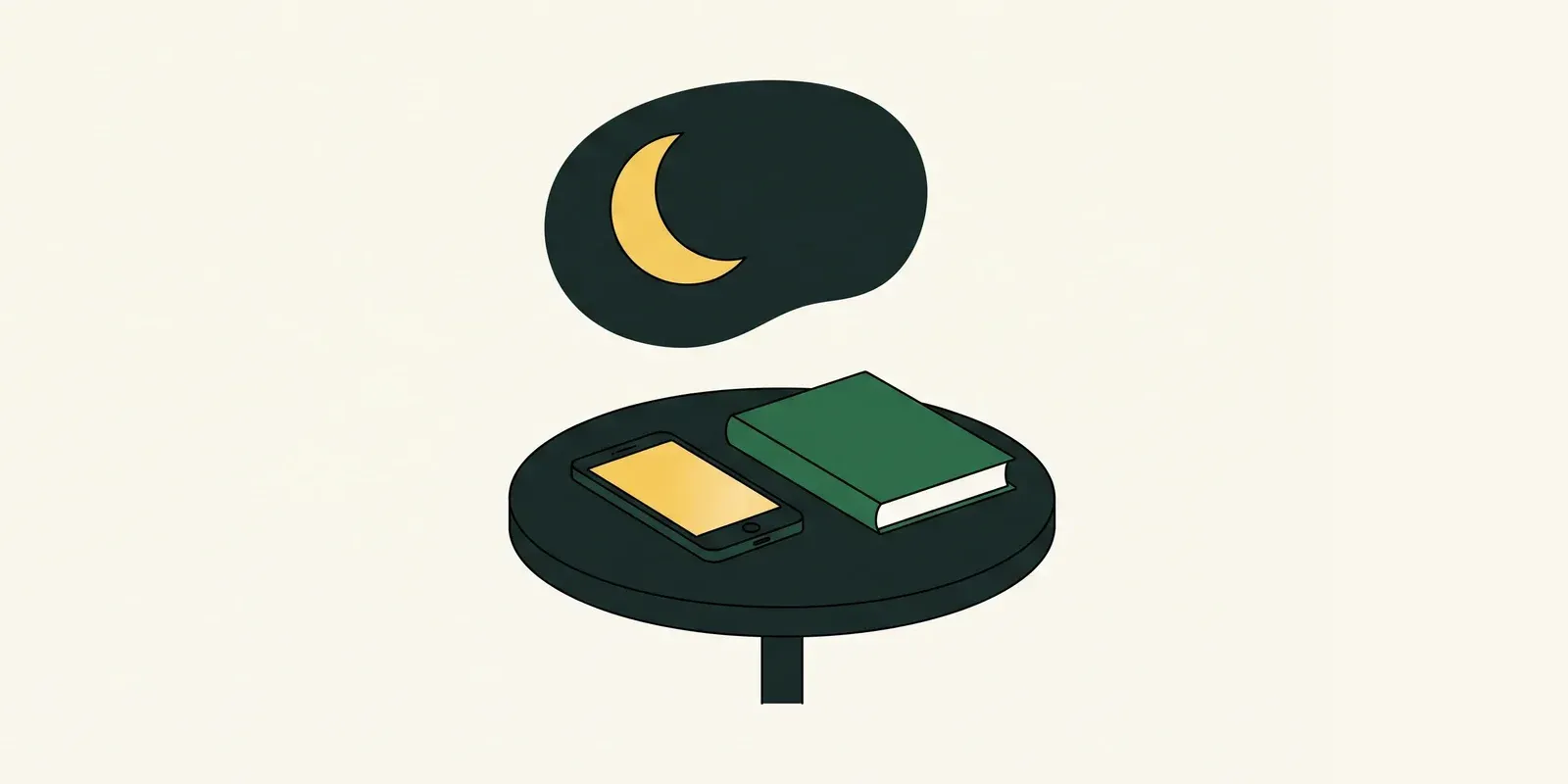
The easiest scroll to resist is the one you can’t reach. Charge your phone in the kitchen or hallway, and use a cheap alarm clock instead. If that feels too drastic, start with across the room: having to get up is often enough.
3. Take your free time earlier
If you’re the deliberate type, the problem isn’t the phone, it’s that the day left you no time of your own. Block out an hour in the early evening that belongs only to you, and protect it like an appointment. When the evening already had some “me time”, the night has less to make up for.
4. Let your phone wind down with you
Both systems have a bedtime setting that does some of the work. On iPhone, the Sleep Focus and Downtime in Screen Time silence notifications and limit apps at a set time. On Android, Bedtime mode in Digital Wellbeing switches the screen to grayscale and mutes the phone. Our guide to blocking apps on iPhone and Android shows the steps.
5. Turn the screen gray
A grayscale feed is surprisingly boring. Bedtime mode on Android does this automatically, and on iPhone you can set a color filter in the accessibility settings and turn it on with a shortcut. It won’t stop you, but it takes away a lot of the pull.
6. Replace the feed with something that ends
You don’t have to go to bed bored. Choose something with a natural stopping point: a chapter of a book, one episode with autoplay turned off, a podcast with a sleep timer. The difference from a feed is that the end comes by itself.
7. Make the feed cost something at night
Mindless scrolling starts with a reflex: you pick up the phone and your thumb opens the app before you’ve decided anything. A short pause at that moment gives the decision back to you. That’s the idea behind apps that put a hurdle in front of certain apps at certain hours, such as Braintoll, more on that below. Our guide on how to stop mindless scrolling covers this and other ways to break the habit.
8. If you lie awake anyway, take it seriously
If you stay up because you know you won’t fall asleep, the phone may be a symptom rather than the cause. Trouble falling or staying asleep that lasts for weeks is worth talking to a doctor about. Going to bed later and later rarely fixes it.
Is it good to study before bed?
A little, yes, and this is one of the few things worth doing on your phone at night. Sleep helps new memories settle. In a 2006 study by Steffen Gais and colleagues, high school students remembered vocabulary better when they slept within a few hours of learning it than when a whole day of being awake came in between.
A 2016 study by Stéphanie Mazza and colleagues went further. Forty adults learned 16 word pairs in Swahili and French. Those who learned in the evening, slept and relearned in the morning needed about half as many attempts to get all the words right again as those who learned in the morning and relearned the same evening. A week later, they remembered 15 pairs on average, compared with 11.
So a few minutes of flashcards before sleep are well timed. A few minutes, though: an hour of studying in bed is still an hour less sleep. Our guide on how to memorize vocabulary has more on fitting reviews around sleep.
A toll on your feeds after 10 pm
Braintoll combines point 7 with the flashcards before sleep. Choose the apps you scroll at night, for example Instagram or TikTok, and set active hours for the night. A time window ends on the day it starts, so for 10 pm to 6 am you add two: 10 pm to midnight and midnight to 6 am. During those hours, opening one of them shows a few flashcards first. Answer them, rate how well you knew them, and the app opens for as many minutes as you’ve set. When that time runs out, the cards come back, even mid-scroll, so the feed finally has a natural stopping point.
Or tap Keep my attention and put the phone down. Either way, the last thing you did was a few minutes of learning instead of another hour of videos. During the day Braintoll stays out of your way. It’s free for one app, on Android and iPhone.
To be honest about it: a toll makes scrolling more deliberate, but it doesn’t stop you. If you want the strongest effect, charge the phone in another room and let Braintoll handle the evenings when it ends up next to you anyway. If you’re not sure how much the phone really takes from your evenings, our free phone habits check helps you look at it.
Common questions
What is revenge bedtime procrastination?
Revenge bedtime procrastination means staying up later than you want, often on your phone, to get time for yourself after a day that felt controlled by work, school or other people. The term spread in 2020 from a Chinese expression. Researchers call the underlying pattern bedtime procrastination: going to bed later than intended without anything stopping you.
Why can’t I stop scrolling at night?
At the end of the day, self-control is at its lowest, and many people feel the night is the only time that’s their own. A feed has no natural end, so there’s never a good moment to stop. Research links bedtime procrastination with lower self-control and with being an evening person.
How long before bed should you stop using your phone?
There’s no exact rule. Gunnhild Hjetland, who led a study of more than 45,000 students, suggests stopping 30 to 60 minutes before you want to sleep if screens affect your sleep. In her study, each extra hour of screen use in bed went with 24 minutes less sleep.
Does night mode or Night Shift help you sleep?
Not much, according to the evidence so far. A 2021 study of 167 young adults found that iPhone’s Night Shift made no difference to sleep. Large studies suggest that the time spent on the phone matters more than the color of the screen.
Is it good to study right before bed?
Short reviews before sleep are well timed, because sleep helps new memories settle. In studies, people remembered vocabulary better when they slept soon after learning. Keep it to a few minutes so studying doesn’t push your bedtime back.
Braintoll is not affiliated with Apple, Google, Instagram or TikTok. All product names are the property of their respective owners.